| TLDR Freelancers and one-off vendors are great for getting started with a marketing strategy. However, a team of individual contributors was not built to carry a brand’s whole strategy, especially when your company is ready to scale. If your marketing content sounds different depending on who produced it, no one can tell you what’s working, and you’re spending more time managing invoices than talking to your customers, you’ve likely outgrown the patchwork model. The solution isn’t more freelancers. Rather, it’s someone who owns the big picture. |
Every growing company starts somewhere. A freelance writer for the blog. A contractor for the website. Maybe someone part-time for social media. It’s an efficient, low-risk way to get marketing moving without the cost or commitment of a full-time hire. For a while, it works. In fact, that’s how Hearthstone began.
But only about half of organizations have a clearly defined value proposition that differentiates them from competitors, according to Hubspot’s 2026 State of Marketing report. Additionally, 40% haven’t documented their brand’s unique value proposition at all. Nailing a POV is difficult for a single, cohesive marketing team. It’s even harder to maintain when multiple freelancers each interpret their client’s value proposition a little differently, on their own timelines, with no single source of truth.
A 2026 study by Constant Contact found something similar from a different angle. 74% of small business owners expect to spend more time on marketing this year and 68% even expect their budgets to increase. However, when asked what would drive ROI, 50% named improving efficiency, not adding more effort. But here’s the thing. Managing multiple marketing vendors tends to counteract efficiency. Another freelancer stitched into a potentially uncoordinated mix means moving parts to manage, not fewer.
So, how do you know if your company is facing vendor sprawl and you’ve outgrown freelancers for your marketing? Consider these seven signs.
Read your last blog post, copy from your last five posts on social media, your three most recent sales emails, and the pages on your website back to back. Do they sound like the same company? If your blog has a formal tone, your social media reads casual, and your emails sound salesy and schmoozy, that’s not a voice problem that can be remedied with a style guide alone. Rather, it’s a structural issue. Each piece of content might be coming from a different person, interpreting a brief differently, with no one reviewing how all of the content connects once it launches.
That disconnect matters even more right now. Constant Contact found that 36% of small businesses are actively creating or refining their marketing strategy in 2026. That’s the time when brand voice should be reviewed closely and if needed reworked entirely so that it’s cohesive across channels, not fragmented further based on your writer that week.
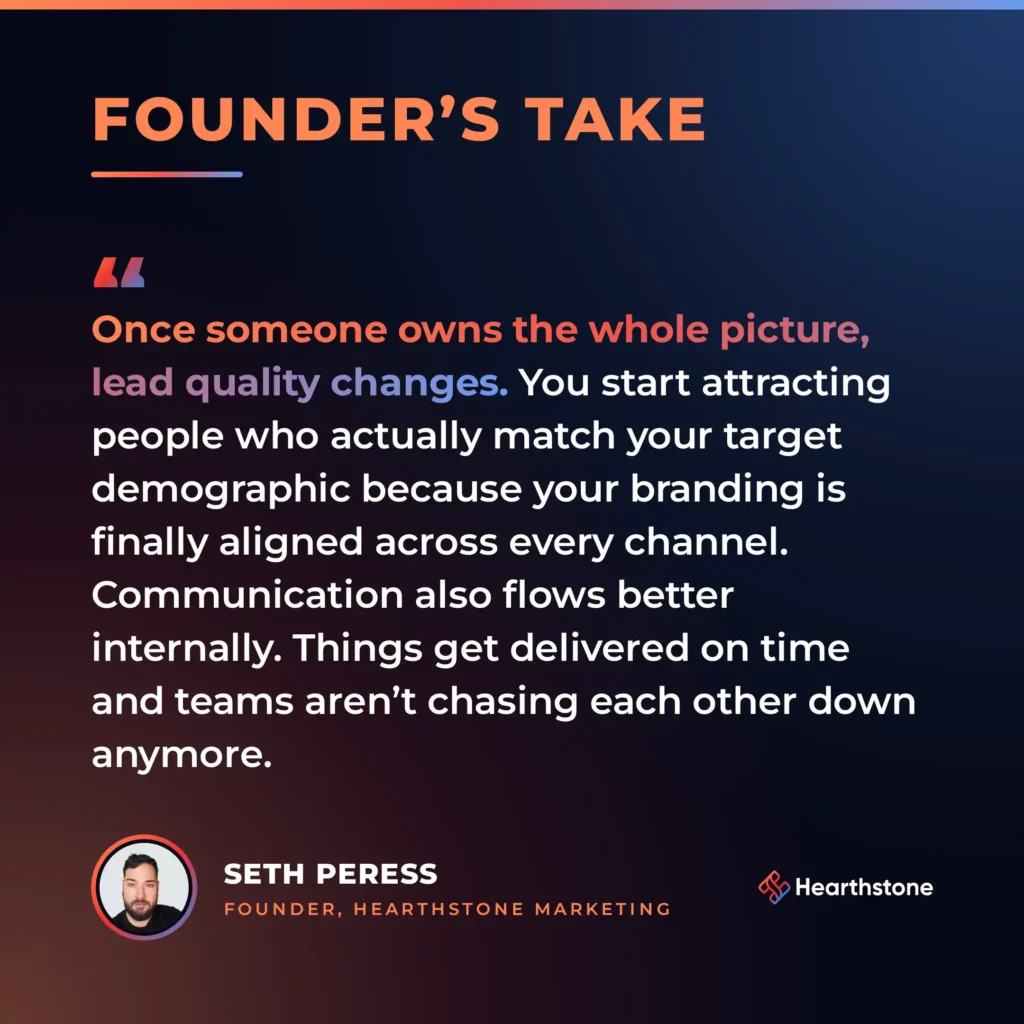
At some point, marketing vendor management quietly turns into more and more time spent approving invoices, chasing down deliverables, and coordinating calendars across several people. That’s time you’re not spending in front of customers, doing the primary research that actually sharpens your positioning. Understanding what your buyers are struggling with right now, what language they use to describe their problem, and why they should choose you over a competitor–all of that is critical work that founders and marketing leads are best able to perform. Freelancer management is a poor use of that advantage.
Here’s the encouraging part. This strategic, brand-driven work is absolutely within your grasp. Plenty of small businesses are already doing it and it’s paying off. In the Hubspot report, the branding investments that small business marketers say deliver the highest ROI include brand awareness campaigns (27%), customer experience alignment with brand promises (21%), and brand messaging framework development (17%). This research indicates that this work can be done at companies with any budget. What it requires is coordination, the piece that a rotating team of freelancers is not designed to nurture on a long term basis.
Ask your SEO freelancer how marketing performed last quarter, and you’ll get a rankings report. Ask your social media contractor and you’ll get engagement numbers. Ask your web developer, and you’ll get site traffic. What you won’t get from any single one of these workers is an answer to the question you actually care about: did any of this move the business forward?
That’s not a failure on any individual vendor’s part. It’s not their job to see the marketing strategy from a bird’s eye view. But somebody needs to have that perspective. Without one person or team looking at how your emails, social media, blog, paid ads, and website work together (or don’t), you’re simply investing in pieces of a puzzle that aren’t creating a cohesive picture.
Positioning erosion or messaging drift rarely happens all at once. It happens incrementally–one freelancer’s slightly-off interpretation at a time. That might look like a tagline reworded here, a value proposition softened there, or maybe a competitor analysis that hasn’t been updated. Eighteen months later, you read back through your own content and it doesn’t sound like you anymore.
This is where the cost of inconsistent brand messaging compounds. Hubspot’s research found that 61% of marketers now believe a strong, distinct brand point of view is more important than ever, especially because AI has made it so easy to produce content that sounds like every other brand’s. If you find that your own messaging is drifting toward generic and that your distinct voice is being watered down with every new vendor, it’s time to consider rethinking your freelance marketing approach.
When a new freelancer joins your team, someone has to re-explain your business, audience, goals, brand voice, and history of what’s already been tested in the market. That onboarding isn’t free. You’re paying for it in time and money with every new hire. Further, because freelancers are not typically expected to document institutional knowledge and learnings when they leave, the process begins from scratch all over again with the next process.
Compare that to a team that retains what’s been tried, what worked, and why. With a cohesive team, a new campaign or initiative can build on the last one instead of reinventing it entirely.
Freelancers are excellent at doing. They write blog posts, build landing pages, run social ads, perform website maintenance, create competitor analyses, and conduct SEO research. What they’re less positioned–or paid–to do is own the strategic why behind that work. Why this campaign? Why at this time? Why this audience? Why this message instead of another one?
That gap becomes more expensive as you grow. In the early days of your brand, “good enough” execution on a handful of channels is fine. But once you’re running the kind of omnichannel presence that Hubspot found the average marketing team now needs, as 75% of marketers use five or more channels, execution without strategy becomes counterintuitive. At this point, you start outgrowing the hiring model you used at the start of your company. It might be time to consider hiring a fractional marketing team or agency.
Here’s the tension a lot of growing companies experience: hiring a full in-house marketing team feels premature, but adding yet another freelancer to the roster doesn’t feel like progress anymore. Rather, it feels like more of what’s already not working. More people to manage, more voices to reconcile, more invoices to track.
That gap–too big for scattered freelance help, but not ready for a full internal department–is exactly where a lot of companies get stuck. It’s also exactly where a fractional marketing partner or full-service agency tends to fit.
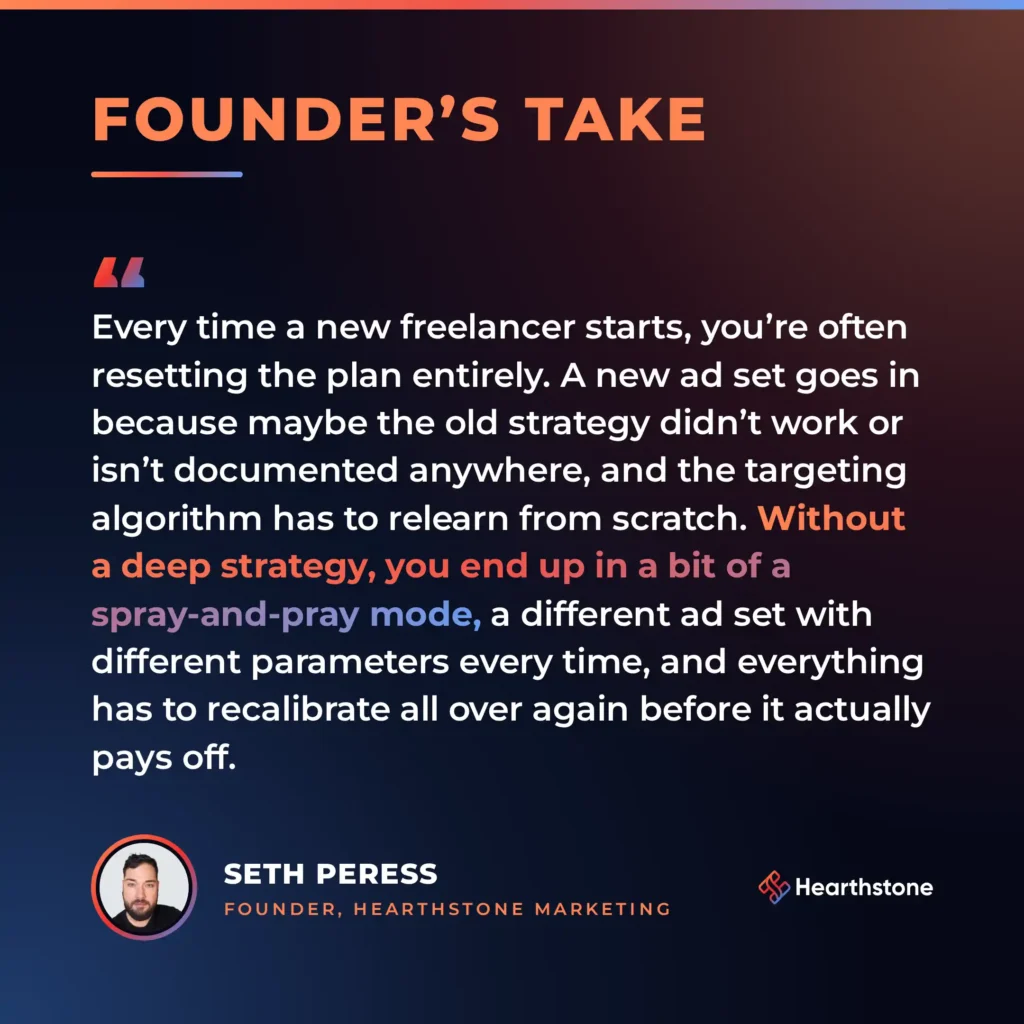
One Hearthstone client, an independently owned, historic boutique hotel in Virginia, had spent years working with freelancers across social media, website copy, and printed marketing materials. Individually, none of the content was bad. But together, it was disjointed, inconsistent brand messaging. The hotel wanted to convey their high-end, yet quaint qualities. Instead, its social media was salesy and its printed handouts even more so. None of it matched the understated, historic character the property actually had in person.
Hearthstone’s solution was to build a brand messaging playbook. The playbook included specific phrases and language the hotel could use consistently across its website, social, and print, chosen so they doubled as SEO-friendly keywords rather than competing priorities. We rewrote their website copy and provided six months of hands-on social media management to give the hotel a voice that actually matched its desired positioning. Things began to shift. Instead of random walk-in tourists exploring the area, the hotel began attracting the wedding business it wanted all along.
Once the new brand voice was resonating with the hotel’s audience and turning that audience into solid leads, Hearthstone gradually transitioned the work to the hotel’s in-house team. We handed off day-to-day social media execution, staying on as backup rather than holding the system hostage. Our goal was to make sure they had a plan for continued success and the ability to run it themselves.
Another Hearthstone client, a new home builder with several communities, came to us after ending a contract with a different marketing agency. They had been working with this vendor for some time, but had almost no helpful reporting to show for it. The only thing they knew was that their Google rankings were dropping. There was no explanation, no analytics, and no context for why. They’d been sold on the promise of ranking first in search, with no visibility into whether that ranking was actually generating business.
When Hearthstone stepped in, we discussed how ranking first isn’t the goal on its own. Rather, the goal is creating a strategy for where that traffic should flow once someone lands on their website. In the first 90 days, Hearthstone is running full website and social channel audits, setting up proper analytics and conversion tracking, launching a strategy with data-backed recommendations, and presenting a 90-day report along with a next-quarter roadmap. The target isn’t a ranking number. It’s more contact form submissions and traffic actually reaching the right pages.
If the problem you’re solving is “we need a specific skill,” i.e. someone to run paid ads, another freelancer might actually be the right fit. If the problem is “no one is connecting our strategy across people we already have,” adding another freelancer will make that worse, not better.
Not at all. Hearthstone works with freelancers regularly, and for good reason. They’re often the fastest, most cost-effective way to bring in specialized skills for a specific project without the overhead of a full hire. The signs in this blog aren’t about freelancers doing bad work. They’re about what happens when nobody is coordinating that work under one strategy.
In fact, a fractional marketing team layered on top of your existing freelancers can be exactly the fix. In this model, someone owns the strategy and makes sure everyone’s work adds up to something bigger than any single deliverable, while the freelancers you already trust keep doing what they do best.
A freelancer typically owns one deliverable or channel. A fractional marketing team owns the strategy connecting all of them, which means planning, execution, and reporting are owned by the same people, with senior-level strategic thinking included rather than billed separately.
It depends entirely on how many freelancers you’re currently paying and how much of your time is dedicated to managing them. Many companies find the real cost of the freelancer model was never just the invoices. It also included time spent hiring, firing, and coordinating instead of growing the business.
Try this exercise. Gather your most recent 10-15 pieces of content. Pull from your website, social media, emails, and ad copy. Read them back to back. Inconsistent brand messaging, contradicting claims, or tone variations are brand voice inconsistencies worth taking seriously.
If even just two or three of these signs sound familiar, it might be time for an honest look at how a coordinated approach could help your business grow.
Hearthstone’s free marketing analysis takes an in-depth look at your current marketing channels and performance. It’s a comprehensive, complimentary deep-dive into your current marketing function, and will give you clarity on whether it’s time to move beyond scattered freelance help.